DG - REALITY AND THE SYMBOLIC
Between the Raw and the Rendered
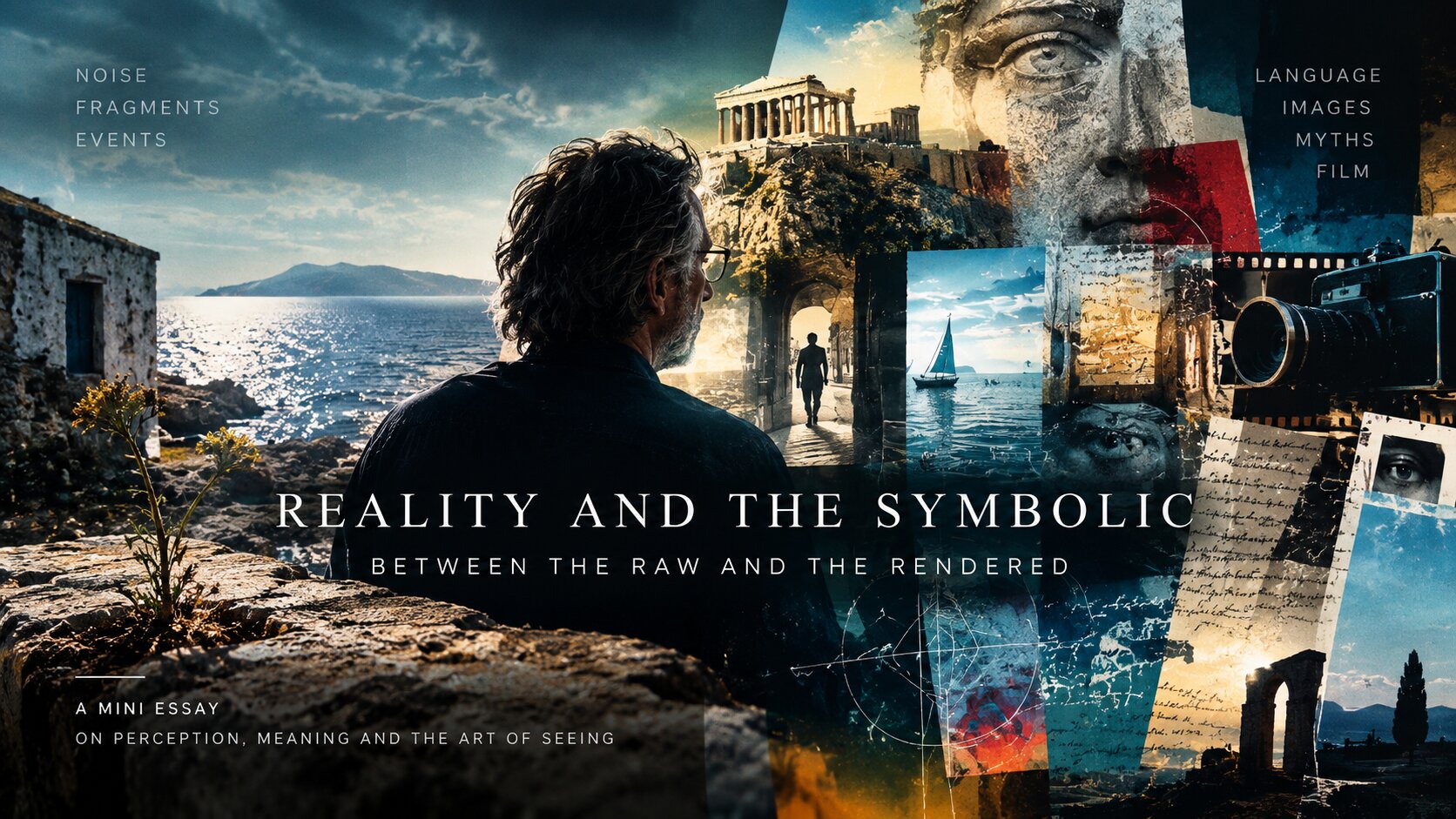
REALITY AND THE SYMBOLIC (SYNOPSIS)
Between the Raw and the Rendered: The Architecture of Cinematic Transformation
The unmediated world arrives as an indifferent, fragmented continuum of raw matter—stone, light, bodies, and sound—that carries no intrinsic narrative and refuses to explain itself. To inhabit this overwhelming expanse, human consciousness constructs the symbolic layer through art, language, montage, and ritual, not as an evasive veil over truth, but as an active operational rendering that binds disparate impressions into intelligible form. Through deliberate framing, rhythm, and symbolic condensation, the filmmaker refuses mere reproduction, extracting resonant ciphers from the friction of existence so that reality's raw fragments begin to converse and render the world habitable. There are two versions of this text: one in English, and one further down in German.
THE SUBTERRANEAN STRATA
A Note on Further Exploration
This represents an immensely complex subject with far-reaching implications; what is presented here is merely the first plunge of the spade into the earth, while the deeper subterranean terrain still demands exhaustive exploration.
The primary inspiration for these preliminary reflections stems directly from the philosophical and cinematic investigations of Ernst Cassirer, Nelson Goodman, Andrei Tarkovsky, Wim Wenders, among others.
There are two versions of this text: one in English, and one further down in German.
REALITY AND THE SYMBOLIC (EN)
Between the Raw and the Rendered
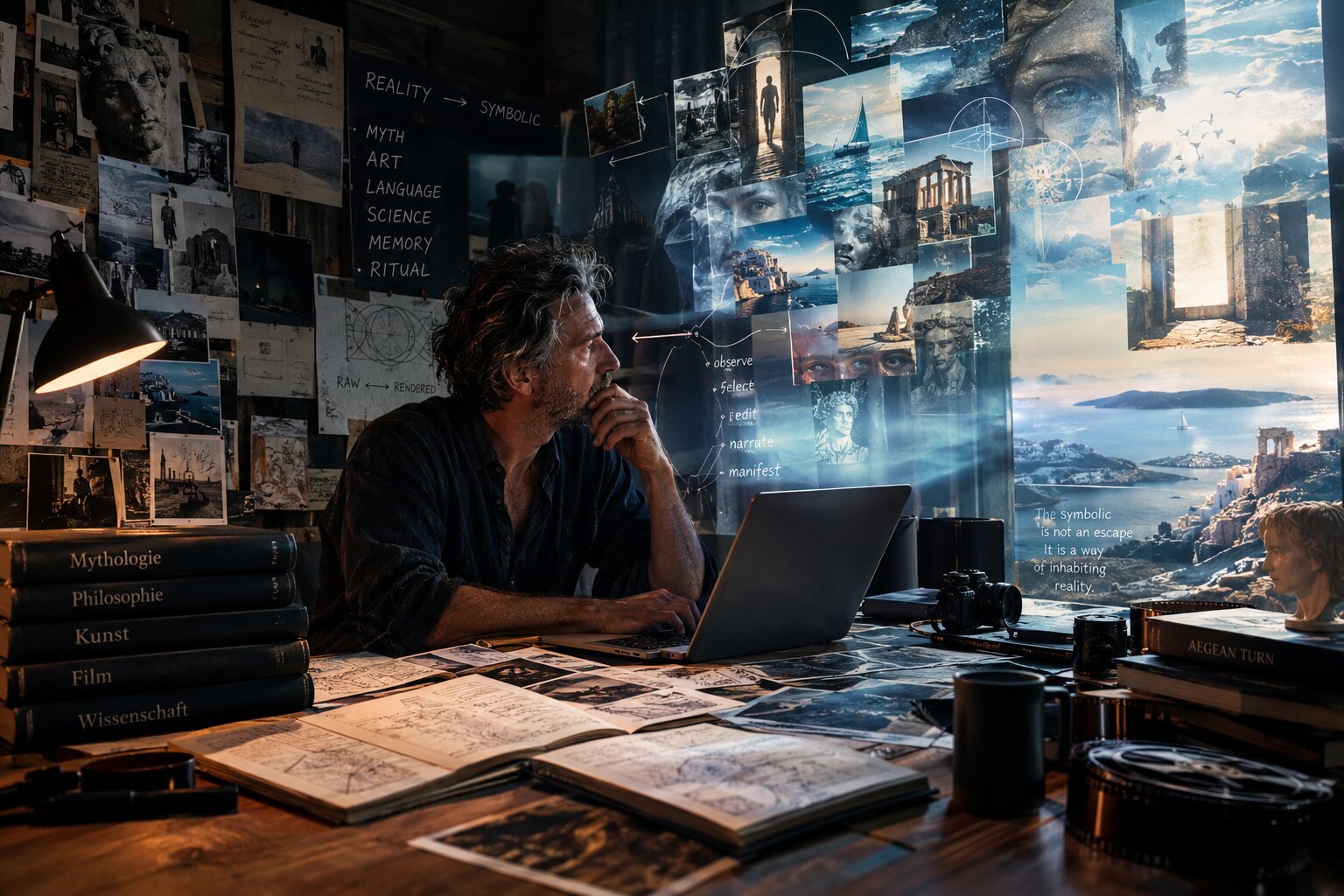
The world does not arrive as a story.
It arrives as material.
Light. Sound. Bodies. Stones. Faces. Movement. Smells. Accidents. Pain. Weather. The sound of the sea. Footsteps beneath an archway. A ruin in the evening light. A red suitcase standing against a wall.
None of these things carries a narrative by itself.
Reality, in its raw state, is a continuum of impressions — dense, fragmented, indifferent. It happens before it acquires meaning. Perhaps this is precisely what makes reality so difficult: the world does not explain itself.
We respond by creating the symbolic.
Language, myth, art, science, memory and ritual are forms of rendering. They do not simply receive the raw world; they translate it into forms through which it can be perceived, remembered, shared and inhabited.
The symbolic is therefore not a veil placed over reality.
It is an active layer between ourselves and the world.
We do not simply see reality.
We see a rendered reality.
Every image is already a decision. Every name cuts something out of the continuum. Every film begins with the selection of a frame. Every memory is montage. Every narrative is an arrangement of fragments.
The camera, therefore, is never a neutral eye.
It records reality — but framing, duration, perspective, focus, movement and editing transform that reality into another order of experience. The material remains real; meaning emerges through the relationship between its fragments.
This is where symbolic condensation begins.
A place becomes a cipher. A ruin becomes a space of memory. The sea becomes movement, boundary or possibility. A door can suddenly become an image of freedom — not because the door inherently means freedom, but because experience, memory and repetition have charged it with meaning.
The symbolic does not replace the real.
It makes visible what has not yet appeared as a relation within the real.
The task of the artist, then, is not to reproduce the world as completely as possible. It is to extract form from the excess of reality without destroying its resistance.
Raw is not the opposite of rendered.
The rendered remains bound to the raw. It is its second mode of existence.
Film is therefore neither reality nor illusion. It is a transformation of reality into meaning.
Perhaps this is the essential work of the filmmaker: not to explain the world, but to create conditions in which its fragments begin to speak to one another.
The image then ceases to be merely a representation of the world.
It becomes a second world.
A world of cuts, rhythms, repetitions, traces and ciphers.
Not an escape from reality.
But a way of inhabiting it.
REALITÄT UND DAS SYMBOLISCHE (DE)
Zwischen dem Rohen und dem Gerenderten
Die Welt kommt nicht als Geschichte zu uns.
Sie kommt als Material.
Licht. Geräusche. Körper. Steine. Gesichter. Bewegungen. Gerüche. Zufälle. Schmerz. Wetter. Das Rauschen des Meeres. Ein Schritt unter einem Torbogen. Eine Ruine im Abendlicht. Ein roter Koffer, der an einer Wand steht.
Nichts davon trägt von sich aus eine Erzählung.
Das Reale ist zunächst ein Kontinuum von Eindrücken — dicht, fragmentarisch, indifferent. Es geschieht, bevor es Bedeutung erhält. Vielleicht liegt genau darin seine Härte: Die Welt erklärt sich nicht.
Der Mensch antwortet darauf mit dem Symbolischen.
Sprache, Mythos, Kunst, Wissenschaft, Erinnerung und Ritual sind Formen des Renderns. Sie nehmen das Rohe nicht einfach auf, sondern übersetzen es in eine Form, in der es wahrgenommen, erinnert, geteilt und bewohnt werden kann. Das Symbolische ist deshalb kein Schleier, der über die Wirklichkeit gelegt wird. Es ist eine operative Schicht zwischen uns und der Welt.
Wir sehen nicht einfach die Welt.
Wir sehen eine gerenderte Welt.
Jedes Bild ist bereits eine Entscheidung. Jeder Name schneidet etwas aus dem Kontinuum heraus. Jeder Film beginnt mit der Auswahl einer Einstellung. Jede Erinnerung ist Montage. Jede Erzählung ist eine Ordnung von Fragmenten.
Auch die Kamera ist deshalb kein neutrales Auge.
Sie nimmt Wirklichkeit auf — aber erst durch Ausschnitt, Dauer, Perspektive, Fokus, Bewegung und Schnitt entsteht daraus eine filmische Wirklichkeit. Das Material bleibt real; seine Bedeutung entsteht in der Beziehung der Teile.
Hier beginnt die symbolische Verdichtung.
Ein Ort wird zu einer Chiffre. Eine Ruine wird zu einem Gedächtnisraum. Das Meer wird zu Bewegung, Grenze oder Möglichkeit. Eine Tür kann plötzlich für Freiheit stehen — nicht weil sie an sich Freiheit bedeutet, sondern weil Erfahrung, Erinnerung und Wiederholung sie mit Bedeutung aufladen.
Das Symbolische ersetzt das Reale nicht.
Es macht sichtbar, was im Realen noch nicht als Zusammenhang erscheint.
Darum ist die Aufgabe des Künstlers nicht, die Welt möglichst vollständig abzubilden. Sie besteht vielmehr darin, aus dem Übermaß des Wirklichen eine Form zu gewinnen, ohne dessen Widerstand zu zerstören.
Raw is not the opposite of rendered.
Das Gerenderte bleibt an das Rohe gebunden. Es ist dessen zweite Existenzform.
Der Film ist deshalb weder Realität noch Illusion. Er ist eine Transformation von Realität in Bedeutung.
Vielleicht ist genau das die eigentliche Arbeit des Regisseurs: nicht die Welt zu erklären, sondern Bedingungen zu schaffen, unter denen ihre Fragmente miteinander zu sprechen beginnen.
Das Bild wird dann nicht zum Abbild der Welt.
Es wird zu einer zweiten Welt.
Eine Welt aus Schnitten, Rhythmen, Wiederholungen, Spuren und Chiffren.
Nicht Flucht aus der Realität.
Sondern ihre Bewohnbarmachung.